DDoS Response and Availability Incidents
24/7 Emergency Hotline for DDoS response: 1 (833) 562-5273
DDoS response and availability incident response focus on restoring uptime, mitigating malicious traffic, and protecting critical systems during attacks designed to overwhelm infrastructure, applications, or networks. Lockard Security helps organizations stop attacks in progress, stabilize services, and prevent repeat disruption.
What DDoS and Availability Incidents Are
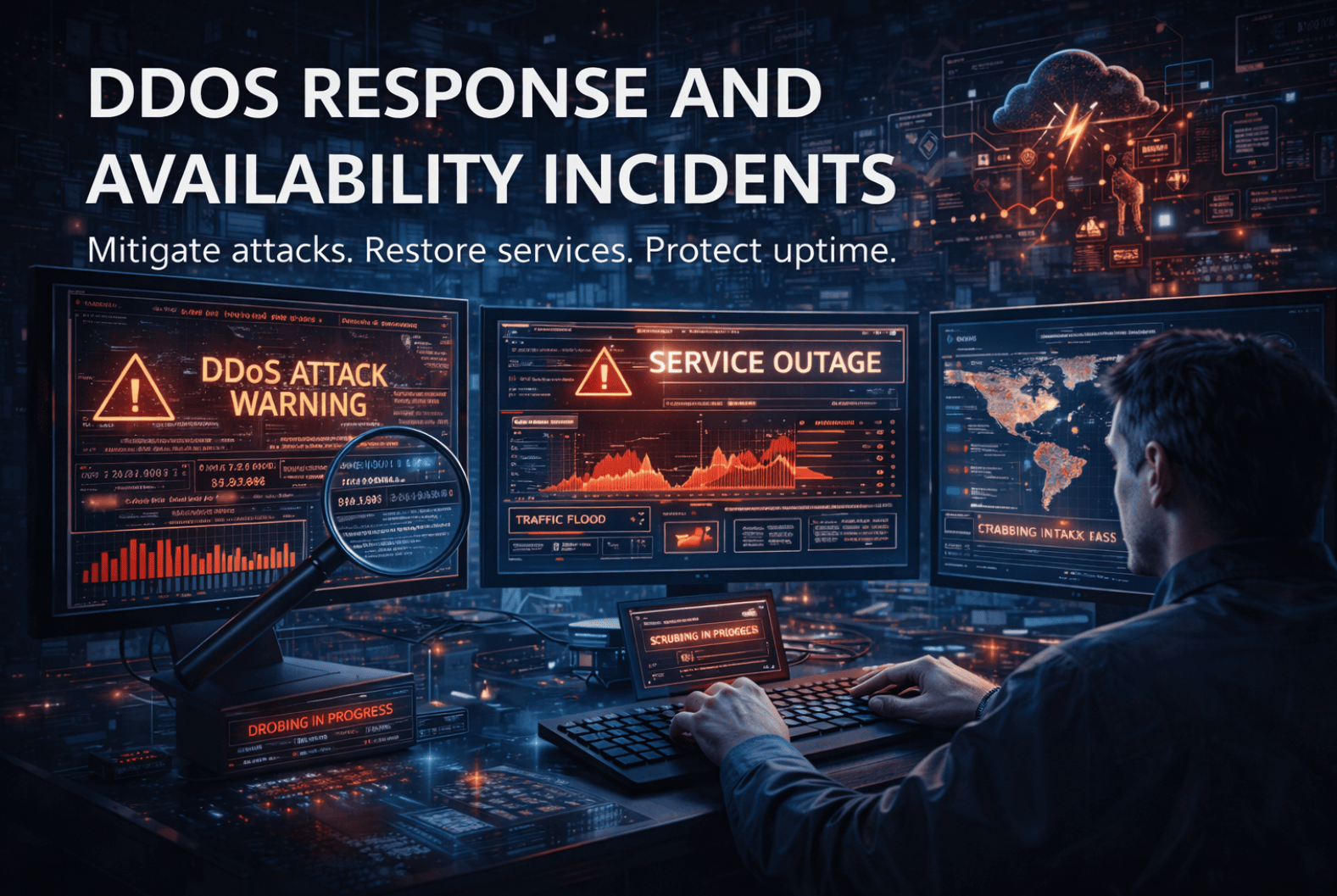
Distributed Denial of Service attacks and availability incidents aim to make systems unreachable rather than steal data. These events are often tied to extortion, hacktivism, competitive disruption, or diversion during broader intrusion campaigns.
Modern attacks frequently blend volumetric floods, protocol abuse, and application-layer exhaustion, making response as much about architecture and coordination as raw bandwidth.
Common DDoS and Availability Attack Types
Volumetric attacks
Large traffic floods designed to saturate bandwidth using reflection or amplification techniques.
Protocol abuse
Exploiting weaknesses in TCP, UDP, DNS, or other protocols to exhaust infrastructure resources.
Application-layer attacks
Targeting web applications or APIs with low-volume, high-cost requests that mimic legitimate traffic.
Extortion-driven DDoS
Attacks paired with ransom demands or threats to continue disruption if payment is not made.
Our DDoS Response and Availability Incident Process
Effective response requires coordination across networking, cloud, application, and provider layers. We focus on fast mitigation first, then stabilization and long-term resilience.
1) Immediate mitigation
Traffic filtering, rate limiting, scrubbing, and provider coordination to reduce attack impact quickly.
2) Service stabilization
Restore availability, prioritize critical services, and reduce cascading failures.
3) Investigation and attribution
Analyze traffic patterns, attack vectors, and infrastructure weaknesses exploited during the event.
4) Hardening and prevention
Improve routing, scaling, WAF rules, CDN configuration, and monitoring to reduce future risk.
Platforms and Environments We Support
- Cloud providers: AWS, Azure, GCP
- CDNs and edge protection: Cloudflare, Akamai, Fastly
- Load balancers, reverse proxies, and API gateways
- On-prem and hybrid network infrastructure
- Web applications and customer-facing APIs
24/7 DDoS Response and Availability Incident Help
If your organization is experiencing service outages, traffic floods, or extortion-driven availability attacks, contact us immediately. Faster mitigation usually means shorter downtime and lower cost.